Emma Grede 5 min read
How Did Cardi B Fund Her Music Career Before Label Money?
See how Cardi B financed her music career before label money by betting on herself. Read the full story now.
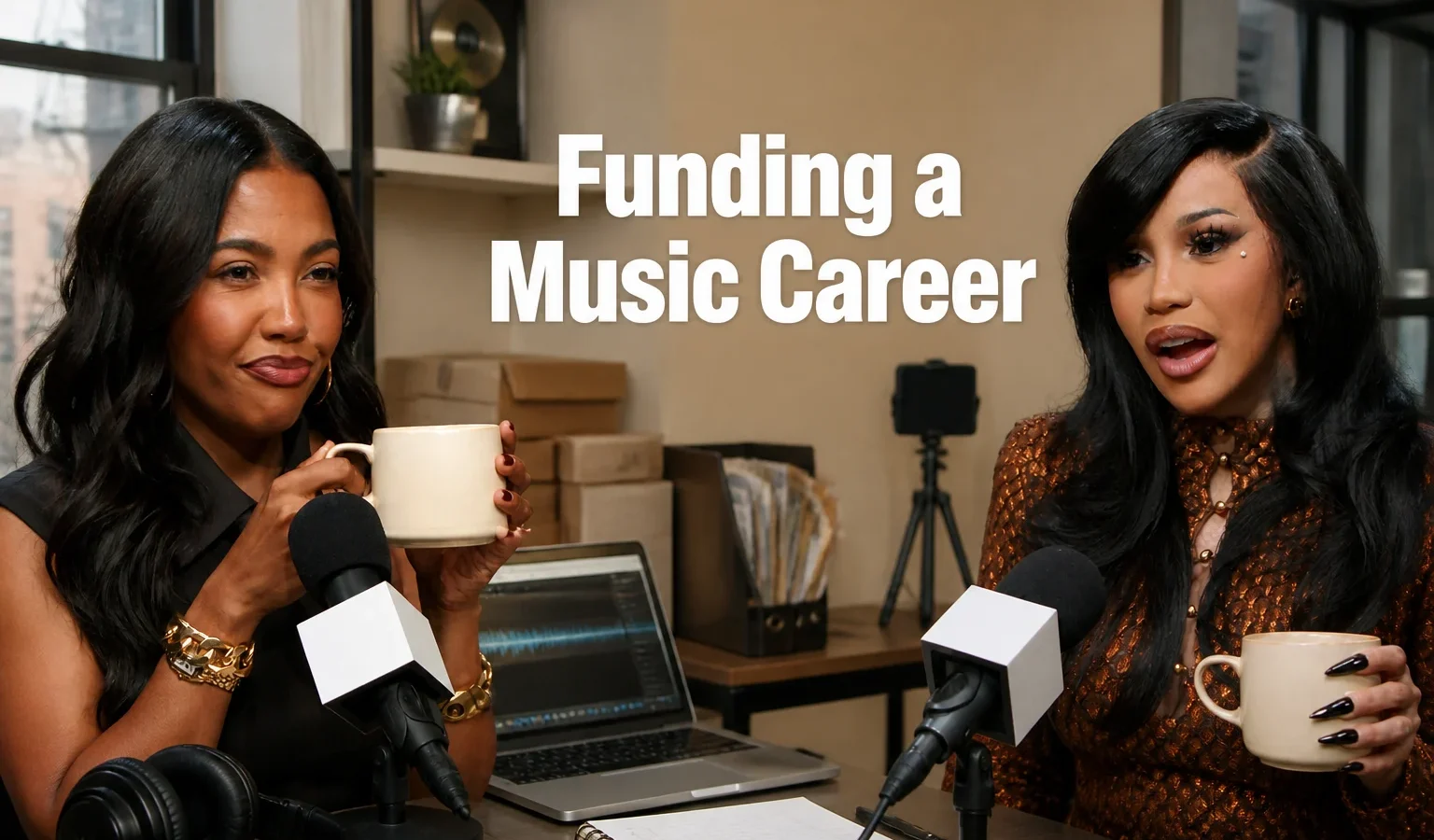
This article draws on our conversation with Cardi B.
Before any serious backing showed up, Cardi B financed her own music career the hard way: she kept earning, then pushed that money straight back into becoming an artist.
Cardi B says she grew up poor in the Bronx, loved clothes, and felt the pressure of wanting a bigger life while money kept telling her no. She did not treat that as the end of the story. She says she decided early that poverty was not going to be where her life stopped.
She paid for the artist before anyone else did
Cardi B says the early structure around her was simple: no manager or label was covering the real costs of building a music career. Her first manager did not have money, and she says nobody was writing checks for studio time, clothes, or the basic pieces that go into creating an artist people can see and hear.
So she became the one funding the buildout herself. She says every dollar she made from hosting clubs and promoting other people’s businesses went back into her music career. Later, when reality TV started bringing in money, she put that into the same goal too.
The important part in her account is not a glamorous origin story. It is the pattern. She earned money in one lane, then moved it into another lane that had no guaranteed return yet. That meant the work around the music was not separate from the music. Hosting, promotion, image, studio time, and output all fed the same plan.
Cardi B describes a period where she was not waiting for the industry to validate her before she spent seriously on herself. She was already acting like the project mattered. In her version, self-belief was not abstract confidence. It showed up as paid invoices.
Why did Cardi B spend her own money on a music video?
Cardi B says she spent her own money on a music video because she saw the downside and the upside at the same time, and decided the shot was worth taking. She describes paying for a video and being left with $2,000 after it (11:10).
That detail matters because she does not present self-funding as comfortable. She presents it as a choice made under pressure. In the same example, she explains the logic that justified the risk: if the song and video hit, they could pull a million YouTube views, and from that momentum she thought there was a path to $30,000 coming back out (11:17).
That is how Cardi B describes her music career decisions before label money entered the picture. She was not spending for appearances. She was spending against a possible breakout. The video was not a luxury line item in her telling. It was a bet on visibility, traction, and the chance to turn attention into cash that could fund the next move.
Her explanation also shows how she measured opportunity. She was not waiting for perfect safety, because perfect safety would have meant not moving. She was looking at whether one expensive push could change the scale of what came next.
She moved fast because slow work burns cash
Cardi B says she worked quickly because speed helped her stretch limited money into more output. She says she could make a song in two days (13:20).
That line fits the rest of her account. If you are self-funding a music career, time is not neutral. Every extra day in the studio, every delay, every half-finished idea carries a cost. Her answer was to turn money into finished work fast, while the energy, the cash, and the opportunity were still there.
That speed also connects back to the way she talks about wanting more from life while growing up in the Bronx. She wanted clothes, wanted a way out, and did not accept being poor as a fixed identity. In her account, ambition was not only about dreaming big. It was about moving fast enough to make your own money do more than one job.
Emma Grede’s conversation with Cardi B leaves a clean answer to the funding question: long before the business treated her like an investment, she treated herself like one first.
FAQ
Did a label pay for Cardi B’s early music career?
No. Cardi B says no manager or label was paying for studio time, clothes, or the core costs of building her as an artist in those early stages.
What income did Cardi B use to back her music career?
Cardi B says she used money from hosting clubs and promoting other people’s businesses, and later put reality TV money into the same goal.
What made Cardi B think self-funding was worth it?
She describes a clear risk-and-reward calculation around a music video: she could be nearly cleaned out afterward, but a breakout result could create major views and bring meaningful money back.
How fast was Cardi B working on songs at that stage?
Cardi B says she could make a song in two days, which shows how urgently she was trying to turn limited resources into finished music.
What is the main lesson from Cardi B’s early approach?
The main lesson is that she did not wait for outside belief. She put her own earnings behind her music career and acted as the first investor in herself.
Listen to the full episode
Watch the full conversation on YouTube — the episode goes further than any article can, and subscribing means you catch the next one.
 Watch this episode on YouTube · Subscribe to Emma Grede
Links from this episode
Mentioned in the episode. Some of these may be affiliate or sponsored links.
This content was created with the help of AI (Antradus AI - gpt-5.4).